Where Did We Even Go? The Beautiful, Baffling Blackout of Scottsdale's Copy-Paste Nightlife
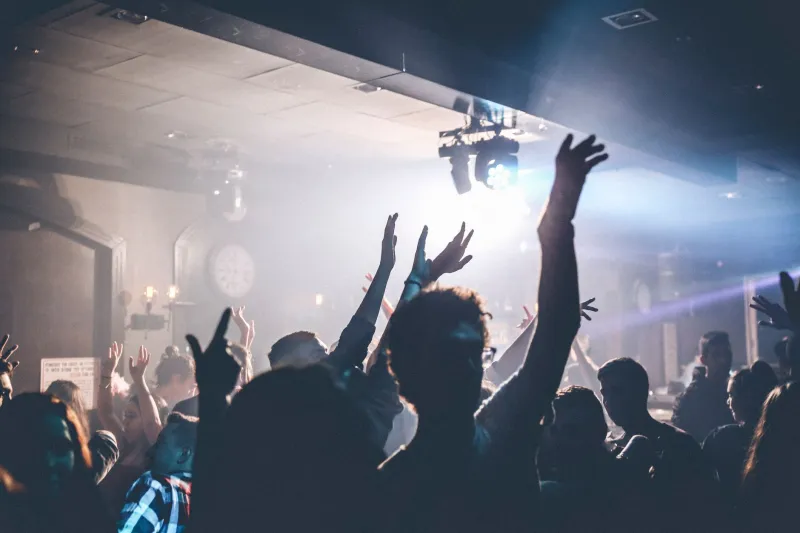
Sunday morning. Your phone has 47 photos that all look identical — same neon, same angles, same group of people holding the same overpriced cocktail in the same shade of electric blue. Your Venmo history shows payments to three different venues you cannot, for the life of you, place on a map or distinguish from one another. You remember dancing. You remember a DJ drop that felt genuinely religious at the time. You remember someone's birthday, though whose is now anyone's guess.
This is not a hangover. This is Scottsdale doing exactly what it was designed to do.
The Great Venue Blur
Ask anyone who goes out regularly in Scottsdale to describe the difference between three clubs they hit on a given Saturday, and watch the performance of confusion unfold in real time. They'll squint. They'll reference the bathrooms — "one had those black marble sinks" — before trailing off into silence. They'll mention a vibe without being able to name it. "It was, like... louder? But also more bottle-service-y?"
This is not a memory failure. This is an architectural achievement.
Scottsdale's nightlife corridor — Old Town and its sprawling, glittering orbit — has quietly perfected what urban planners might call venue homogeneity and what the rest of us call the reason you can't explain to your Tuesday self where your Saturday money actually went. Dark interiors. Pounding EDM at a legally questionable volume. Cocktail menus that rotate through the same twelve ingredients with different names and a $22 price tag. Bottle service that exists primarily as a territorial marker rather than an actual hospitality offering. The aesthetic variables are cosmetic. The experience is, functionally, identical.
By Design, Not by Accident
Here's the part nobody in the industry wants to say out loud: the blur is the business model.
When venues are interchangeable, loyalty becomes impossible. When loyalty is impossible, you return not because you remember loving a specific place but because you vaguely associate the general zone with a good time. You're not returning to a venue. You're returning to a feeling that could be reproduced anywhere within a six-block radius. The venues know this. They're counting on it.
Think about the last time you genuinely recommended a specific Scottsdale club to someone with any conviction. Not "Old Town is fun" or "just go to that area on a Saturday" — but an actual, specific endorsement of a particular establishment with a reason attached. If you can do it, you're in the minority. Most regulars operate on a vague geographic loyalty rather than any meaningful brand distinction.
The cocktail menu is a perfect microcosm of this strategy. Venues rotate their drink offerings frequently enough that you can never pin down what you ordered last time, which means you can never replicate the experience and therefore can never say you've "done" that venue. You're always, technically, trying something new. The menu changes. The recipe does not.
Interviews With the Amnesiac
We talked to a group of regulars — people who go out in Scottsdale at least twice a month — and asked them to describe their last Saturday night in venue-specific detail. The results were illuminating in the worst possible way.
"We started at... the one on Scottsdale Road. The one with the outdoor section that has those fire things," offered one 28-year-old marketing coordinator, gesturing vaguely at the concept of fire. "Then we went somewhere darker. It had a DJ booth that was like, raised? And then I think we ended up somewhere with a rooftop but I'm not sure if that was the same night or the weekend before."
A 31-year-old in finance described his usual rotation as "basically the same room with different names," which he said without irony and without complaint. He spends, by his own estimate, $400 to $600 on a typical Saturday night. He could not, when pressed, tell us what specifically he gets for that money beyond "the experience."
"The experience" came up repeatedly. It is the nightlife industry's most useful and most meaningless phrase. It explains everything and describes nothing. It is the fog that makes the blur feel intentional rather than hollow.
The Psychology of Coming Back for Something You Can't Name
Dr. Whoever-Studies-This would probably have a field day with the neurological mechanics of Scottsdale nightlife. Loud music compresses memory formation. Alcohol — especially in the quantities the drink pricing subtly discourages you from moderating — further erodes the brain's ability to encode episodic detail. Dim lighting removes visual anchors. The result is an evening that felt enormous in the moment and exists only as a vague emotional residue by morning.
But here's the twist: that residue is positive. You feel, broadly, like you had a good time. The specifics are gone, but the emotional signature remains. And that emotional signature is what you're chasing the following weekend, when you head back out into the same corridor, to a venue that may or may not be the same one you were at before, to drink a cocktail whose name you'll forget before you finish it.
Scottsdale has essentially gamified nostalgia for an experience you never fully formed in the first place.
Is Anyone Actually Having a Distinct Experience?
Occasionally, yes. The venues that break through the blur tend to have something genuinely specific — a chef-driven bar program that actually tastes different, a room with a layout so unusual it lodges in memory, a resident DJ with a recognizable sound rather than a playlist assembled by algorithm. These places exist. They're just outnumbered by the copy-paste operations that make up the bulk of the Old Town economy.
The irony is that the venues working hardest on Instagram presence — the ones engineering the most photogenic moments, the most shareable aesthetics — are often the least memorable in person. You remember the photo. You don't remember being there.
The Morning-After Math
So here's where we land, Sunday morning, bank statement open, photos scrolled through with the detached curiosity of an archaeologist examining artifacts from a civilization you apparently belonged to twelve hours ago.
You spent real money. You had a real night. You are left with approximately zero retrievable information about what specifically you paid for or where you specifically were. And somehow — this is the genius, the dark genius — you are already vaguely thinking about doing it again next weekend.
The Scottsdale shuffle isn't a glitch in the nightlife matrix. It's the whole operating system. The venues don't want you to remember them individually. They want you to remember the feeling, which is stateless, brandless, and infinitely renewable.
See you out there. Wherever "there" turns out to be.